
In 1936, Walter Benjamin theorized that the mass reproduction of works of art would rob them of their aura, the “here and now” granting an original greater value than a copy. In 2023, entertainment statistics firm Luminate estimated that 50% of vinyl record purchasers do not own a record player.1 What’s going on here? What makes vinyl continually popular in the face of streaming; what does it do that streaming doesn’t? For the artist, it offers finer control over the listener’s experience, without a rent-seeking middleman controlling the presentation of their work; for the listener, it offers the increasingly fantastical experience of owning a thing.
The task of discovering and purchasing a record from a brick-and-mortar store is instructive, since the purchaser must evaluate not only the work they are purchasing but the condition of the specific copy in front of them (a $2 clearance bin full of mostly black artists, old jazz and R&B, ring wear in the sleeves; a new pressing of a Taylor Swift album at $30, still shrink-wrapped). This is where Benjamin’s aura-loss theory of mechanically reproduced media starts to break down, as customers value each individual record as a specimen based on its characteristics; at Hyde Park Records I was tempted to open discogs.com on my phone, checking previous sales for the particular pressings I was buying to verify whether I was getting a “good deal” (I wasn’t), as I analyzed both the record’s subjective value (is the album any good?) and its resale value (indicated by its cosmetics). Streaming services trying to compete with the Spotify near-monopoly distinguish themselves by gushing about their lossless 24-bit hi-fi audio codecs; vinyl records, meanwhile, are one of the only forms of media that visibly degrade in quality (and resale value) every time they are consumed, the little details adding up–the ring wear on a sleeve, the stray hairs stuck to the surface of the disc, the price tag affixed a little too firmly to the jacket such that it cannot be peeled off without ripping the cardboard.
In effect there are two different systems at play that curate the subset of records acceptable to the purchaser: the store’s organization of records first by genre and then by artist name alphabetized (encoding the implicit assumption of a direct one-to-one mapping between artist and genre, keeping Tyler the Creator in the hip-hop bin), and the differential between the record store’s pricing and the fair-market value of a record in that specific condition. The latter factor is more unique to an analog medium that continuously degrades in quality. A CD either plays or it doesn’t; binary error-correction checksums ensure identical sound each play, and this principle carries forward to audio files and streaming services. A vinyl record, as a friend jokingly remarked when I told him I was writing this paper, “sounds...warmer”, yet the focus on this assumed disparity in sound quality (which is, of course, digitally reproducible, as most modern turntables provide USB audio output for recording) obscures the actual economic characteristic unique to the vinyl record, its differing form as a commodity continuously evaluated on a scale of wear. Vinyl purchasers, in other words, value vinyl for the aura: its resale value makes it a unique fit as a collectible to demonstrate to others that you’re a true fan (hang it on your wall!), and its initial sale price ($30 for a new pressing!) lends credence to the belief that you’re ethical for responsibly compensating the artists you patronize. Even if you don’t own a record player, what would be worth thirty seconds of passive labor-time (listening to one ad) is worth over four hours of federal minimum wage to you when etched into PVC.
This economic analysis, though it may explain why people buy vinyl, ignores the most distinctive feature of vinyl when it comes to the actual listening experience: its packaging and distribution as a thing you must pick up and open to listen to, its status as a work whose author has defined how you must interact with it. At Hyde Park Records I purchased two LPs, John Lennon and Yoko Ono’s Unfinished Music No. 1: Two Virgins and John Coltrane’s Expression. By chance both records I had purchased incorporate physical, paratextual detail in ways simply impossible on a streaming service, where the music could come as a shuffled entry in a playlist or an algorithmic recommendation without any context besides the audio itself.
Expression, the first posthumous Coltrane release, has the late jazz pioneer’s dates of birth and death printed on the front cover; inside the gatefold is a kind of obituary explaining the album’s significance as the product of the last recording session of Coltrane’s life. One cannot listen to the record without being faced with its status as the last mark on the world the artist made. Listeners are required to reckon with, as the text puts it, Coltrane’s relegation to “so antithetical an end as non-being”. The inclusion of one of the tracks on a jazz playlist, as music in isolation and not work in its entirety, would leave it devoid of significance.
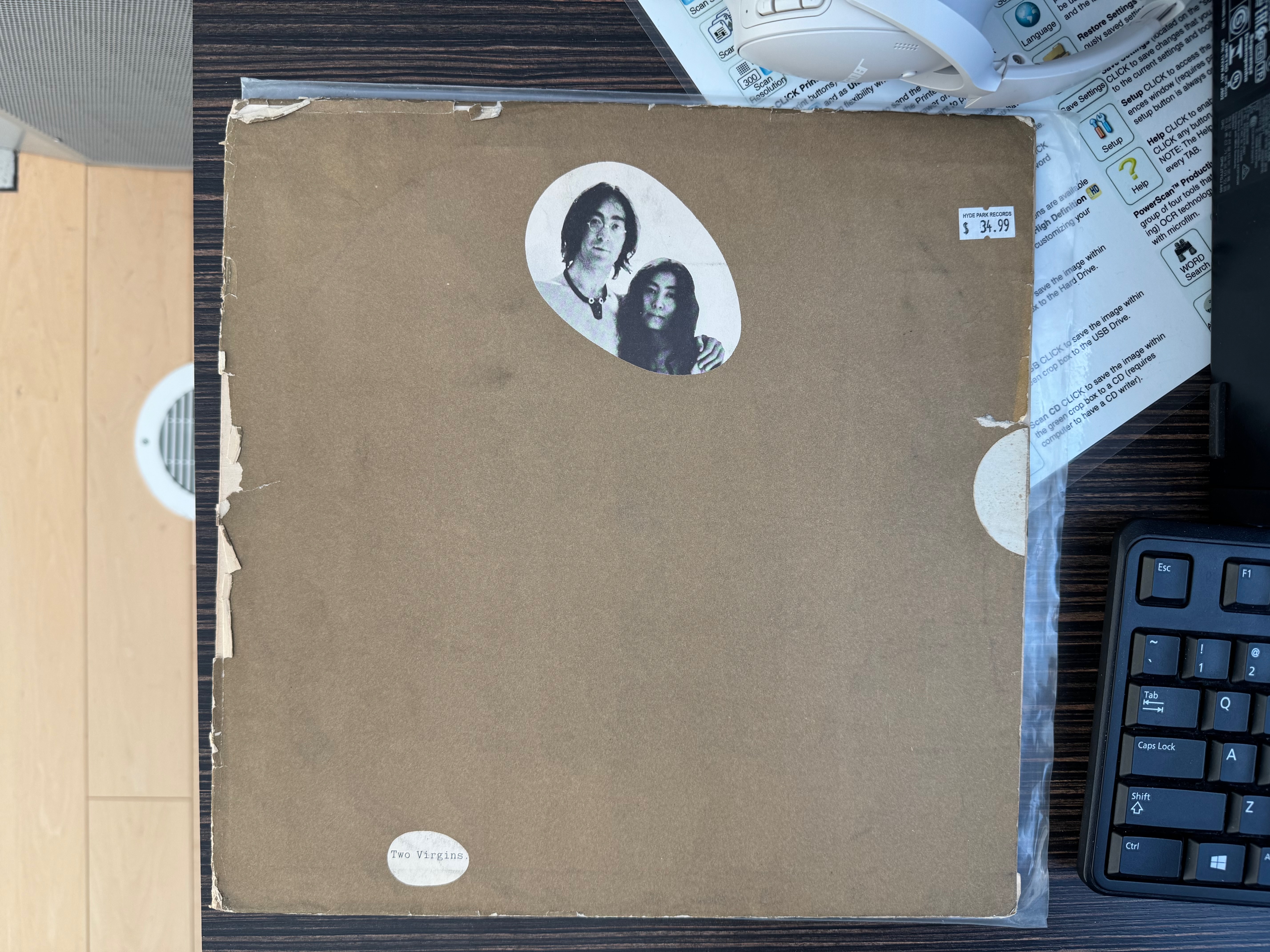
By contrast, Two Virgins offers no explanation, no track listing, no information of any kind besides a title, date, location, and Bible verse. The verse, the last section of Genesis 2, explains that Adam and Eve felt no shame in being naked before they ate the forbidden fruit, in a sense defending the album’s cover art (a nude photograph of Lennon and Ono embracing) against charges of obscenity. Public controversy surrounding the cover led the distributor to sell the album in a brown paper censorship sleeve that must be removed to access the record, completely recontextualizing the cover: instead of making a statement about nudity as natural and normal, the act of listening to the music now feels violating, voyeuristic—you cannot hear the album without removing the sleeve, without undressing John and Yoko. The sleeve was already split open on my copy and pieces of paper frayed off and fell onto the Mansueto Library floor as I slid the record out. One day it will have torn completely, leaving the nude photograph permanently exposed. No other copy is torn in quite the same way as mine. On streaming services, the censored cover is used and the listener can safely avoid having to think about the whole thing.
The constraints by which one must interact with art are set by the medium in which it is fixed, and vinyl constrains the listener more than any music format invented since. The needle keeps moving forward; conscious action is needed to seek it to a particular track. Vinyl encourages the consumption of albums as complete artistic objects rather than collections of decontextualized audio; but the machinery surrounding vinyl, the focus on its collectability and the manufacture of its rarity, simultaneously subverts the fungible commodity form of music through emphasis on the particular characteristics of a given copy–near mint, well-worn, limited edition alternate color pressing. This dizzying array of adjectives serves to mask the part of the vinyl-listening experience that actually feels novel, exclusive, and occasionally worthy of a limited-edition pressing of 500 translucent galaxy purple editions: the conversation with the music you enter into when you put the needle down.
The Joe + Rika Mansueto Library Listening Room
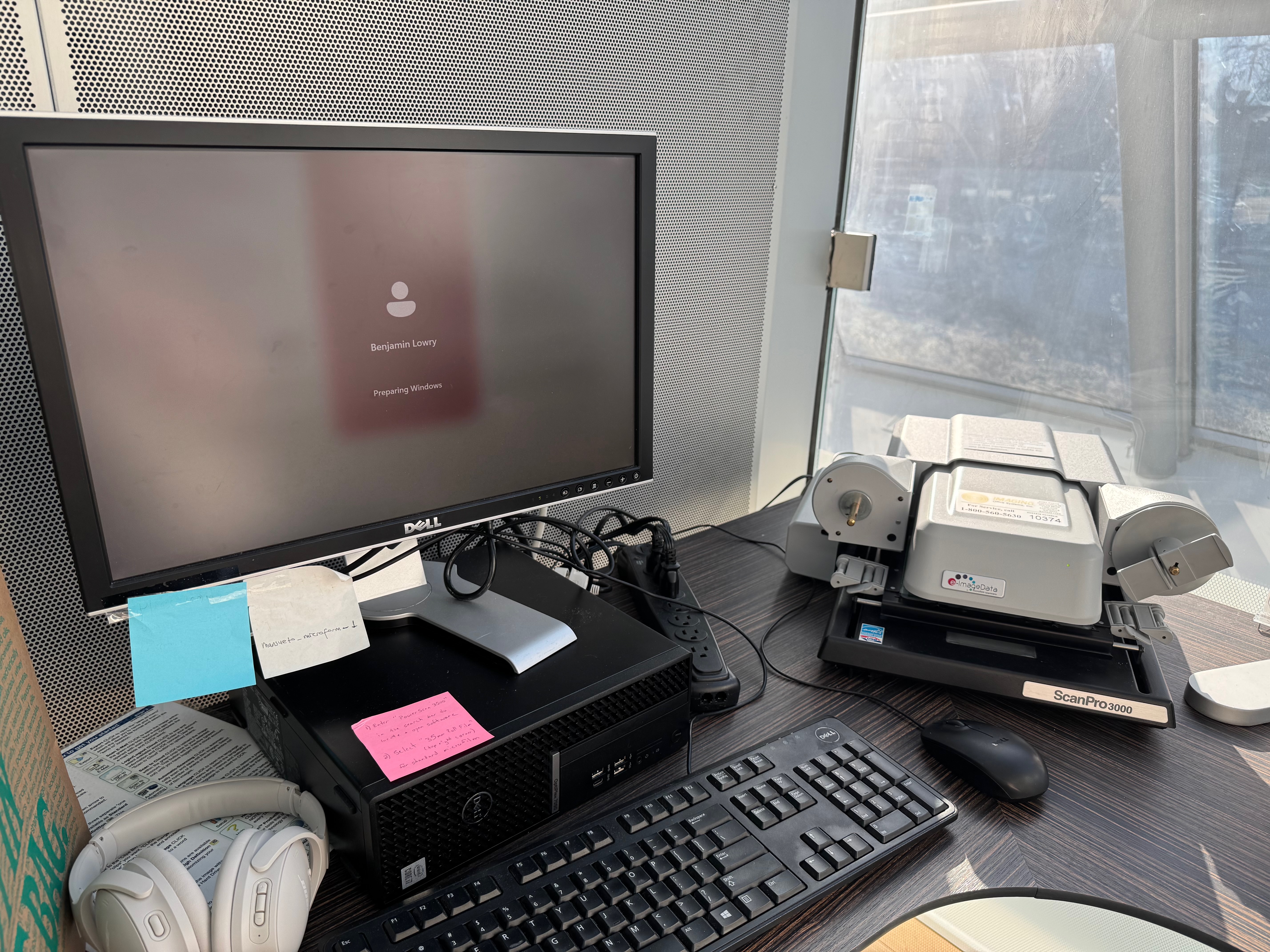
It’s nice having Ethernet for once in the building with the worst Wi-Fi across all of campus. Entering the listening room feels like an exclusive experience at first (the rest of Mansueto is crowded as hell right now with everyone studying for midterms, but here’s a nice spacious cubicle all to myself, noise-insulated and shielded from people–or rather they’re shielded from me since I’m still recovering from a cold), but you soon realize the entry door is glass so anybody who happens to walk by is going to see the naked photo of John and Yoko on the album cover. Bringing the record onto bus 172 (now that you live up north on 52nd there’s nowhere safe for you to store things near here) feels like some kind of smuggling exercise because somehow this photo of two naked humans–not the least bit sexual–seems contraband, the sinking suspicion that somebody might be peering over your shoulder, looking into your reusable bag from Whole Foods and recognizing the LP inside it. That’s why you bought the John Coltrane record too, Expression, because even though it cost thirty dollars it makes a good censor for the scandal behind it and maybe you’ll listen to it one day anyhow.2 That’s the advantage of portable music-listening tech, from Walkmen to streaming: they’re built to withstand over-the-shoulder glances. Nobody knows what you’re listening to on your phone until you pull it out of your pocket to skip the song. (Two Virgins has censored cover art on streaming services.) I brought my own pair of headphones (Sennheisers, not pictured, that were nice until the entire headband frayed away) but couldn’t use them because they only have a 3.5mm connection and the audio interface is 5¼ inch. There’s a perfectly fine 3.5mm-to-5¼ adapter sitting right here but it’s been connected to the library-provided headphones for so long that it’s permanently melded into the cable. This turntable doesn’t have a lever that drops the needle so I have to put it down myself and that scares me. Vinyl is one of the only forms of media that visibly degrades in quality (and resale value) every time it is consumed.
I absentmindedly set down the paper liner that holds the LP on top of the outer jacket, only realizing just now that doing so perfectly crops the image through the circular cutout in the center so that you can only see John and Yoko’s genitals and not their faces. Maybe it’s a good thing for my sake that the right channel of these headphones doesn’t work. Something approximating rhythm just appeared, a sequence of piano chords. It doesn’t sound good but it’s the most intentional-sounding thing I’ve heard yet, and it just went away, drowned out by some operatic screaming. I can see the passerby on Ellis Avenue and every time someone walks by with earbuds in I think about how different the thing they’re listening to must be. John just said something and for the first time it was coherent enough that I could tell he had a British accent, but I still didn’t make out the words past “it’s just me”. There was just a glissando down the keyboard, another scream and presumably this is how Side A ends. But first some more tuba-esque sounds. John says “thank you” and the side ends. I reach over to pick up the needle and before I can grab it, it picks itself up, automatically moves back to its cradle, and the record stops spinning. I didn’t know they made them like that nowadays. I finally got the 3.5mm adapter to come off the headphones they provided, which means I can now use my Sennheisers to listen to both channels of this fascinating composition. I’ve begun to stare at every pedestrian that passes by to see if they notice me. Nobody in Mansueto has walked by the room, thank God there haven’t been any confused stares. This album doesn’t actually benefit from stereo that much (I write as I re-listen to part of side A despite professing not to have enjoyed it), since almost everything is panned to the center. Yoko just made a noise that sounded identical to the sound Mail.app plays when you get an email. You can fairly convincingly make the point that this composition is valueless as music but it certainly has value as audio. Listening to it makes you feel a way few other things make you feel; it’s hypnotic in a way, it’s completely incidental but decidedly not just random noise. There’s something human about it. Time to flip the vinyl over. I wish I had an antistatic brush with me because there’s an entire human hair stuck to side B and I have no way of getting it off without touching the surface of the vinyl which you’re never supposed to do. Too late, I touched it anyway because it was bothering me. I just put my palm down on the table to pick up the mouse and noticed it made a sound through my headphones via the vibration lifting the needle slightly. Now that I’m listening for it, I notice that every keystroke I make while typing does the same thing. I think I had just tuned it out before.
Now there’s something that sounds intentional. There’s a deep, buzzing audio distortion, like a sawtooth wave. It’s all I can hear. It’s like the start of “Waters of Nazareth” before the drum backing comes in. You could make a hell of an album just by sampling instrumental from this record and looping it. It seems like they’ve silently settled on a structure where Yoko makes shrill noises and John improvises some musical accompaniment on whatever is within arm’s reach. There’s a weird skill at play here, to produce a backing that (though unpleasant to listen to) sounds like it’s supposed to go with the speech. I feel like she just said “ちょっと”. There’s a sound in there that feels like the THX note. A guy just walked by the room for the first time to use the printer, he didn’t even notice me because he had a singular mission and that mission was to print a document for approximately 8 cents a page. The album is almost over, apparent both from the sense of finality the last few noises they’re making have and from the needle approaching the center ring. Printer guy just walked by and I only just noticed that as he was walking away he was staring directly at me. I made eye contact for a fraction of a second and he disappeared behind the wall, almost concurrently with the needle reaching the silence at the end of the concentric structure, the rings of screaming relentlessly repeated. This entire album feels oddly voyeuristic so it’s only fitting that the guy walking back to his seat from the printer became my voyeur at the end. But I don’t know if he noticed what album I was listening to, perhaps he did, perhaps he was just delighted by the fact that he saw someone listening to an LP. The expression on his face didn’t give much insight. He looked confused more than anything in that brief instant I knew him. If I saw him while leaving the library in a few minutes I wouldn’t even recognize him. And yet this is the only form of music that will not inevitably recognize me. There is only a digital record of my having listened to this music on this occasion because I chose to make one. On a streaming service the row in a table tracking my play would stay there forever, feeding a stochastic loss minimization function like an ouroboros, and probably recommending to some poor person with similar musical taste to mine that they should also spend their afternoon on Two Virgins. But the record doesn’t remember me, its memory naught but another spiral of erosion on the coastal shores of the audio, faded, slowly forgetting, echoing back into history.